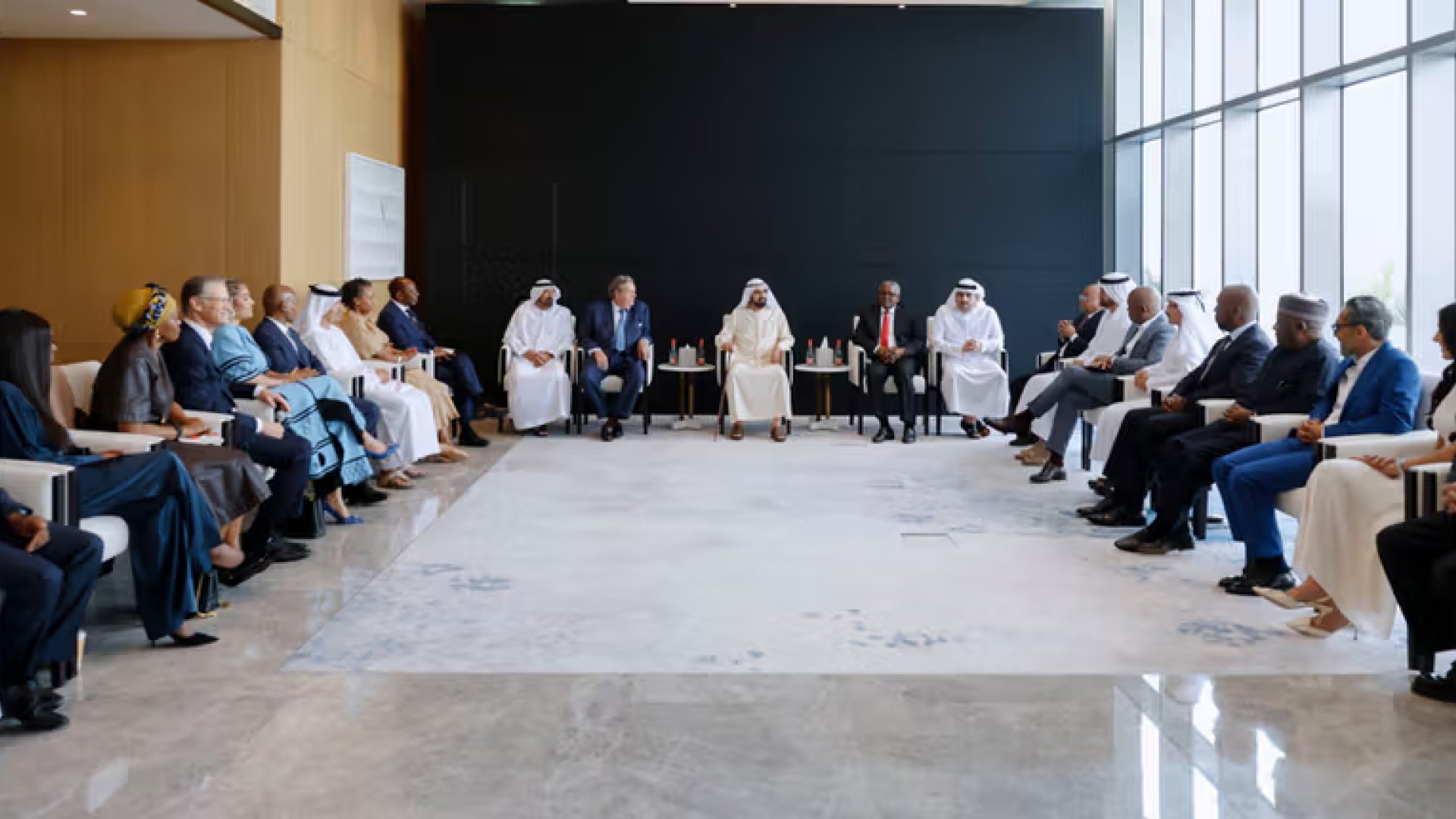
A glassy Dubai meeting room, a tight semicircle of suits, and a number that lands like a weight: roughly $61 billion in combined net worth. It’s a rare moment when Africa’s richest industrialists and investors—Aliko Dangote, Johann Rupert, Nicky Oppenheimer, Nassef Sawiris, Mike Adenuga, Abdulsamad Rabiu, Koos Bekker, and Patrice Motsepe—appear together. The image is more than spectacle; it points to shifting deal geography, with Dubai increasingly acting as a neutral hub where African capital meets Gulf finance, global advisers, and cross-border opportunities.
The first thing you notice is the quiet.
Not the empty kind—the expensive kind. The hush of thick carpet, sealed windows, and an air-conditioning system that seems to breathe rather than blow. Outside, Dubai glitters with that midday intensity that turns glass towers into mirrors. Inside, eight men settle into a shared frame, and for a moment the world feels smaller than it should.
“All of them… here?” someone murmurs near the back, half question, half disbelief.
It’s not every day you can say $61 billion walked into one room and sat down.
The gathering—reported as a rare meet-up of eight African billionaires in Dubai—brings together names that read like a map of modern African enterprise: Aliko Dangote, Johann Rupert, Nicky Oppenheimer, Nassef Sawiris, Mike Adenuga, Abdulsamad Rabiu, Koos Bekker, and Patrice Motsepe. Different accents. Different industries. Similar gravity. The kind that pulls bankers, ministers, lawyers, and would-be partners into orbit.
Seen individually, each of these fortunes has a familiar shape: the long arc of building, owning, scaling. Put them together, and you begin to see an economic storyboard—how wealth is made on the continent and how it now travels.
On paper, they are eight separate stories. In a room like this, they become one message: African capital is not only growing—it is coordinating, traveling, and choosing its stages.
Dubai isn’t just a skyline. It’s an interface.
A place built to reduce friction: direct flights, time-zone convenience between Africa, Europe, and Asia, and a dense professional ecosystem—banks, private wealth managers, legal firms, corporate service providers—ready to assemble a deal structure as smoothly as a hotel checks you in. If London feels heavier and New York feels far, Dubai feels immediate.
Watch the micro-movements and you can almost see the logic. A phone lights up briefly, then disappears. A whispered name, a tiny nod. Meetings arranged in minutes, not weeks. In global business, convenience is not a luxury; it’s leverage.
For African billionaires, Dubai has become a neutral meeting ground—close enough to feel regional, global enough to pull in partners from the Gulf, India, Southeast Asia, Europe, and the US. It’s where you can talk about a port concession and a data center in the same breath, then board a flight back to Lagos, Johannesburg, or Cairo before the week is out.
To the public, a group photo of billionaires can look like pure spectacle. To markets, it’s a flare in the sky.
It says: relationships are being refreshed. Interests are being aligned. Potential co-investments are being tested over coffee and quiet conversation. And in a world where capital increasingly moves in networks—not in straight lines—those rooms matter.
Africa’s macro story remains a mix of promise and pressure: rapid urbanization, huge consumer markets, an infrastructure gap measured in power plants and rail lines, and financial headwinds that show up as currency volatility and higher borrowing costs. In that context, large private fortunes aren’t just wealth—they’re shock absorbers. They can finance factories, de-risk supply chains, and keep projects alive through cycles that would wipe out smaller players.
In a room like this, the talk is rarely dramatic. It’s practical. “What’s the timeline?” “Who’s underwriting?” “Which jurisdiction makes this easiest?” And then, perhaps, the sentence that changes a project’s fate: “I can introduce you to someone.”
Dubai’s rise as a convening point also reflects something larger: the tightening corridor between African opportunity and Gulf capital.
Gulf investors have been increasingly active across African sectors—from energy and logistics to agriculture and infrastructure. At the same time, African entrepreneurs and family offices have been diversifying internationally, building structures that allow them to raise capital, protect assets, and partner at scale. Dubai sits neatly in the middle: a place where African growth narratives can be translated into global investment language.
It’s not just about money flowing out of Africa; it’s about money learning new routes. A holding company here. A co-investment there. A joint venture that starts with a handshake in Dubai and ends with cranes on a waterfront thousands of kilometers away.
Sixty-one billion dollars is an easy headline and a hard number. In some countries, it rivals the scale of public budgets. In business terms, it means access: to credit, to advisory talent, to political audiences, to resilience.
But the number’s real power is not what it buys—it’s what it enables. Options. Patience. The ability to wait for a better entry point, to hold an asset through turbulence, to invest ahead of demand.
And if you listen closely—past the polished photo moment—you can hear what that kind of capital usually talks about: infrastructure. The unglamorous backbone of growth. Cement, ports, fiber, power, housing. The things that turn demographics into GDP.
The surprise of the gathering, then, isn’t that eight billionaires were in the same room. It’s how normal it looks. As if this—cross-border strategy, shared space, global choreography—has become the default setting for Africa’s top tier of private wealth.
This Dubai meet-up is a useful real-estate signal because it highlights where African high-net-worth networks increasingly convene, structure holdings, and originate deals. For property investors, the implications show up in both Dubai itself and in Africa-facing real assets.
1) Dubai demand: prime residential, branded living, and Grade-A offices.
When billionaire and family-office networks use Dubai as a hub, demand concentrates in assets that combine prestige with operational ease: prime villas and penthouses, branded residences, and serviced apartment models that fit frequent travel and security preferences. Professional services also follow capital, supporting demand for Grade-A office space in established business districts and for flexible, high-spec fit-outs.
2) Africa–Gulf corridor: more institutional capital for logistics and infrastructure-adjacent real estate.
Co-investment dynamics between African sponsors and Gulf capital tend to favor cash-flowing, inflation-hedging “real assets”: logistics parks, light industrial, cold chain, and energy-linked commercial nodes. In African metros, this can accelerate demand for warehousing near ports and highways, and for industrial land with credible utilities access.
3) Housing undersupply: scalable mid-market development becomes the core opportunity.
Africa’s fastest-growing cities face chronic housing shortages. The investable gap is often not ultra-luxury but deliverable mid-market housing tied to job centers and transit. Developers who can standardize design, secure reliable materials supply, and package projects with credible financing (rent-to-own, phased payments, employer-backed schemes) are more likely to attract larger pools of capital.
4) Wealth diversification: Dubai property as a liquidity-and-stability play.
For many entrepreneurs dealing with currency swings at home, Dubai real estate can function as a globally tradable store of value with relatively efficient transaction processes. Investors should expect intense competition for best-in-class stock—meaning underwriting discipline matters: location quality, service charges, management standards, and exit liquidity.
5) What to watch next
Bottom line: the “one-room” moment in Dubai illustrates a broader shift—African capital is increasingly networked internationally, and real estate sits at the center as both meeting ground and asset class. For investors, the opportunity is in understanding these corridors early: where capital gathers, where it gets structured, and where it gets deployed into the physical economy.